
Created by Daniel Isheden, optimized for Carbon and tested in EVE Frontier, CORTAO brings greater depth and more natural shading to real-time environments
REYKJAVÍK, Iceland – November 12, 2026 – Fenris Creations today revealed Circular Occluder Ray-Traced Ambient Occlusion (CORTAO), a new open-source rendering technique designed to give game worlds more accurate shading and a stronger sense of depth while keeping rendering costs low. Created by Daniel Isheden, Senior Rendering Engineer at Fenris Creations, CORTAO is available from today through Carbon for developers to explore, integrate and build on.
EVE Frontier: CORTAO Showcase (In-Engine) – YouTube: https://youtu.be/GUQ2kDgGT-c
Ambient occlusion adds the subtle darkening that occurs where nearby surfaces block light from the environment. It helps objects feel grounded in their surroundings and makes the shape and detail of complex scenes easier to read. CORTAO improves the accuracy and stability of this effect, reducing the dark halos and distracting shifts in shading that can appear around objects as the camera moves.
CORTAO calculates this shading in real time without requiring baked scene data, making it well suited to environments that players continually build and reshape. From the contact between small objects to the overlapping structures of a vast installation, the technique helps preserve a consistent sense of depth as the scene changes.
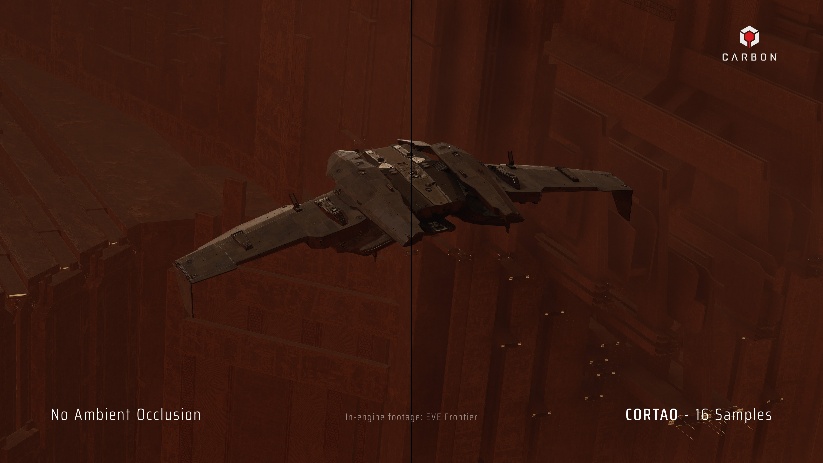
CORTAO began as Isheden’s independent research, with Fenris providing the production environment to test and refine it at scale. The resulting Carbon implementation has been optimized and tested in EVE Frontier, the in-development space survival MMO. Its open space, online battles, megastructures and enclosed interiors provided a demanding proving ground, testing the technique across the extreme scales of a changing, player-created universe.
“Small errors in shading can make an otherwise convincing scene feel wrong, especially when they become visible as the camera moves,” said Daniel Isheden, Senior Rendering Engineer at Fenris Creations and creator of CORTAO. “I wanted to find a more accurate way to handle that within the performance budget games actually have. EVE Frontier gave us a demanding environment to test the approach, and I’m looking forward to seeing how other graphics developers put it to use.”
“Good rendering research needs room to develop, and a game that puts it under pressure,” said Ben Hunter, Director, Core Technology at Fenris Creations. “Supporting Daniel’s work through Carbon allowed us to bring those together. Making the implementation open source means other teams can examine the decisions behind it and adapt it to challenges we haven’t encountered ourselves. That exchange is a big part of why we’re opening up our technology.”
The technique takes a new approach to screen-space ambient occlusion, using information from the current view to represent nearby surfaces as circular occluders and calculate how they block ambient light. Testing demonstrated gains in image accuracy and rendering efficiency, with particularly strong results in visually complex scenes.
For developers, CORTAO offers scalable quality settings to balance visual detail against rendering cost. It is designed to replace an engine’s existing screen-space ambient occlusion stage, allowing the approach to be applied beyond Carbon. The open-source release gives graphics programmers access to the implementation so they can adapt it to their own projects and contribute improvements.
CORTAO’s repo and documentation is available here, with the Carbon-optimized version available here. A closer look at the technique, including visual comparisons and performance results, is available at evefrontier.com/en/news/cortao. Learn more about Carbon at fenris.com/carbon and EVE Frontier at https://www.evefrontier.com/.
About Carbon®
Carbon is Fenris Creations’ cross-platform game engine framework, powering the persistent virtual worlds of EVE Online and EVE Frontier. Its technology supports the demands of large-scale multiplayer games, from real-time rendering to world simulation and networking. Through its growing collection of open-source modules, Carbon gives developers access to technology tested in live game environments, with opportunities to adapt it for their own projects and contribute improvements. Learn more.
About EVE Frontier®
EVE Frontier is an in-development space survival MMO. You awake from stasis as the last relic of humanity from a lost age. Civilization has decayed in the ruin of its ambition, feral drone swarms scour its wastes, and survivors fight to gain control over its resources. In the shadow of the Trinary, who will you become? Learn more: www.evefrontier.com.
Website | Press Kit | Twitter/X | Facebook | Instagram | YouTube | Discord
About Fenris Creations
Fenris Creations is an independent video game developer headquartered in Reykjavík, Iceland, with studios in London and Shanghai. Founded in 1997 as CCP Games on the principle of pushing the envelope and breaking new ground at every level, the company is on a mission to create virtual worlds more meaningful than real life. With the launch of EVE Online in May 2003, the studio established itself as a pioneer of massively multiplayer online games, earning critical acclaim worldwide for its single-shard universe, player-driven economy, and emergent gameplay. Fenris Creations continues to build deep, persistent virtual worlds designed to evolve over decades in close partnership with their communities.
Website | Press Kits | X/Twitter | Facebook | Instagram | YouTube | LinkedIn